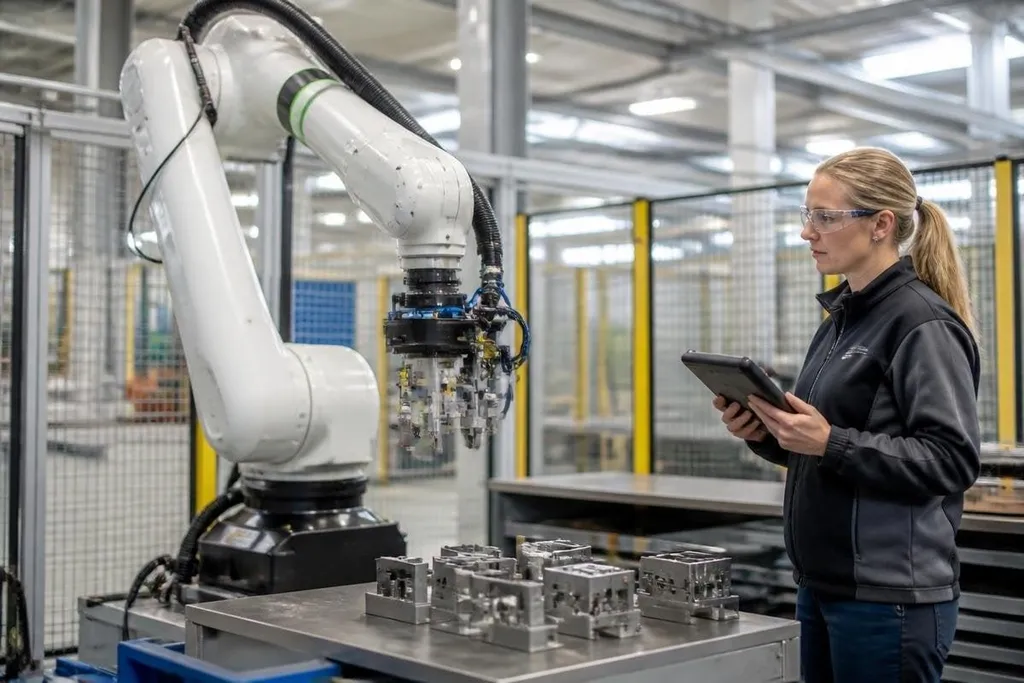
A factory robot used to repeat one motion beside a guarded line. Newer systems are being built to sense changes, handle more task types, and work closer to people. The hard question is whether those abilities reduce work and downtime enough to justify the added cost.
- Robots will need better sensing, not only faster motors.
- Software updates will matter as much as arm hardware.
- Safety, service, and proof on real production lines will decide the buyers.
The arm is only one part
An industrial robot still needs an arm, controller, end effector, sensors, and a way to connect with factory equipment. The next step comes from how those parts work together during a task.
A camera can check the position of a part. Force sensing can tell the robot when a gripper has touched it. A controller can then change the arm's motion instead of repeating the same path after the part has moved.
That helps when bins are not perfectly arranged or when a fixture changes between product runs. It doesn't remove the need for setup.
Someone still has to define safe motion, test the gripper, check the part range, and set limits for speed and force.
The useful question is task fit. Can the robot lift the required payload, reach every work point, keep its cycle time, and recover after a part slips? A factory buyer needs those answers for the actual line, not for a clean demonstration.
Software will decide how much work the robot can handle
Older automation often needed a separate program for each fixed motion. New systems aim to let one robot handle more variation through vision, force control, and software that can be updated without changing the whole cell.
That can cut setup work when a factory makes several products. It can also create a new service burden. A software update may change timing, sensor behavior, or the way the robot responds to an unusual part, so the update needs a test plan before it reaches production.
Robot operating system tools, industrial networks, and simulation software can connect the robot to a larger system. The value comes from a clear result: less manual reprogramming, faster changeovers, or fewer stops while a technician finds the fault.
A factory trial needs the robot’s task and stop behavior recorded, not only a smooth cycle on video. Robot24 can place a machine’s stated limits beside the factory task and date, so you can judge what changed on the floor. That evidence leads to the next test: whether the system stops safely when a person enters its work area.
Working near people raises the proof standard
A robot that works beside a person needs more than a slow setting. Its sensors, control software, stopping behavior, and cell design must work together when someone enters the work area or an object appears in the path.
That changes the layout of the factory. A company may need safety scanners, physical limits, a monitored stop, or a different gripper. The robot also needs clear rules for restart after a stop, because a safe system that takes too long to reset can still damage output.
The same issue applies to mobile industrial robots. A vehicle moving through a plant must detect people, pallets, doors, floor changes, and blocked routes. Its map can be correct in the morning and wrong after a line changes position.
What buyers should ask for
Marketing material can describe a wide range of tasks. A purchase decision needs records from the exact job you plan to run.
- Task record: Ask for an uncut run that shows loading, handling, errors, recovery, and the finished part.
- Performance data: Get payload, reach, cycle time, repeatability, power use, and operating limits in writing.
- Changeover plan: Check how long a technician needs to teach a new part and what tools that work requires.
- Safety case: Ask which sensors and stop functions protect people, then confirm who signs off the cell.
- Service plan: Check spare parts, software support, repair time, and the skills needed on your own site.
These checks also expose what remains unproven. A robot may handle a neat test set and still struggle with reflective parts, dust, poor lighting, changing boxes, or a gripper that wears down during a shift.
The practical decision
Choose newer robot systems when your line has enough task variation to reward better sensing and software. Keep fixed automation when the job is stable, the cycle is known, and a simpler cell already meets the target.
I'd wait for production data before paying extra for broad claims about flexible automation. The useful proof is a measured run on your parts, with your safety layout, your changeover time, and a clear record of every stop.
That test should decide the purchase. Until then, broader robot capability remains a design direction, not a result.